Transform thin lawns into lush turf. Steps on how to over seed fill bare spots, thicken grass, and improve long-term lawn health.
How to Over Seed
A thin lawn doesn’t fix itself. Over seeding means adding new grass seed to your existing lawn without tearing it up. This simple method fills bare spots, thickens turf, and pushes out weeds. If you want a greener, stronger yard, learning how to over seed is the first step.
When Is the Best Time to Over Seed?
Timing matters. The best time depends on your grass type and climate.
- Cool-season grasses (fescue, ryegrass, Kentucky bluegrass) → Best in early fall, when soil is warm and air is cool.
- Warm-season grasses (Bermuda, zoysia) → Best in late spring to early summer, when soil is warm.
Avoid midsummer overseeding—heat and drought cause poor germination. For most homeowners, fall is the safest, most effective season.

Step 1: Preparing Your Lawn Before Overseeding
| Task | Purpose | Tips / Notes |
|---|---|---|
| Mow low (≈2 inches) | Opens canopy for seed | Bag clippings for clean seed contact |
| Dethatch >½ inch | Removes barrier between seed & soil | Use dethatching rake or machine |
| Aerate soil | Improves seed-to-soil contact | Core aeration recommended |
| Test soil pH | Ensures nutrient absorption | Ideal 6.0–7.0; amend with lime/sulfur |
| Rake bare spots | Exposes soil for germination | Loosen compacted soil for better seed contact |
Step 2: Choosing the Right Grass Seed & Materials
| Grass Type | Best Climate | Sun/Shade | Traffic/Drought Tolerance | Notes |
|---|---|---|---|---|
| Fescue | Cool-season | Shade-tolerant | Moderate | Good for shady lawns |
| Ryegrass | Cool-season | Full sun | High | Quick germination, durable |
| Kentucky Bluegrass | Cool-season | Full sun | Moderate | Ideal for lush, dense turf |
| Bermuda | Warm-season | Full sun | High | Best for southern regions |
| Zoysia | Warm-season | Full sun | Moderate | Drought-resistant, slow-growing |
Step 3: How to Over Seed Your Lawn Properly
Now comes the main step:
- Spread seed evenly using a broadcast spreader.
- Apply 3–4 lbs per 1,000 sq. ft. (check bag for accuracy).
- Add more in bare spots and rake gently.
- Ensure seed-to-soil contact by raking or rolling.
- Optional topdressing with compost for moisture retention.
Overseeding is about precision, not dumping seed.

Step 4: Watering & Maintenance After Over seeding
| Stage | Watering Frequency | Watering Depth | Notes |
|---|---|---|---|
| First 2 weeks | 2–3 times/day | Light, surface-level | Keep soil consistently moist |
| 2–4 weeks (seedlings) | 1 time/day | Medium | Encourage deeper root growth |
| After establishment | 2–3 times/week | Deep soak | Maintain healthy lawn & drought tolerance |
Step 5: Troubleshooting Over seeding Problems
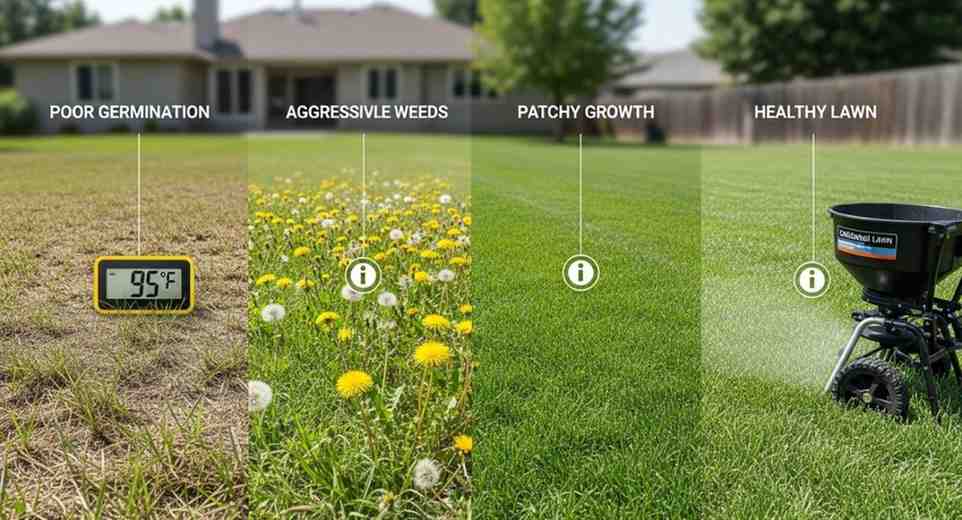
Common issues and fixes:
- Poor germination? → Improve seed-to-soil contact, reseed thin areas.
- Weeds crowding out seed? → Remove weeds before seeding.
- Patchy growth? → Use a calibrated spreader for even coverage.
- Disease issues? → Avoid over watering; choose disease-resistant seed.
- Overseeding in summer? → Wait for fall or spring instead.
Most overseeding problems come from timing or poor prep.
FAQs:
Q1. How often should I over seed my lawn?
Once a year, ideally in fall (cool-season) or late spring (warm-season).
Q2. Can I over seed without aerating?
Yes, but aeration doubles germination success.
Q3. How long after overseeding can I mow?
Wait until grass is 3–4 inches tall, usually 3–4 weeks.
Q4. How much seed per square foot?
Around 3–4 lbs per 1,000 sq. ft.
Q5. Can I over seed in summer?
Not recommended. Heat and drought kill seedlings.
Q6. What mistakes should I avoid?
Overseeding in wrong season, mowing too soon, overwatering, or using poor-quality se + Quick Checklist.